Wednesday, September 13, 2017

700 v Sprint26fs v Expedition, Part 3

Go to Part 1, September 9th
Go to Part 2, September 12th

Suspension
Suspension is what it's all about. It's the driving force behind making a change.

From my last post, The condition of the roads throughout the Central Coast can vary widely. I need to soften up the ride without sacrificing to much speed or weight. Right now some form of light suspension is a must. Whether mechanical suspension like on the Sprint or suspension in form of larger lower pressure tires to be used on the 700 or Expedition, some softening of my ride is a must. 

The ICE Sprint 26fs elastomer rear and front suspension combined with the mesh seat does a superb job at smoothing the chip seal and it handles many road imperfections in respectable style. Using a hard shell seat negates some of the benefits of the full suspension system. It's not a pot hole eater like some of the beefier suspension systems now on the market but then it doesn't weight nearly what some of those other trikes with more substantial suspension systems weight.

Next I revisited the concept of trying to get a smoother ride on my 700 by swapping out the high pressure 28mm Duranos with lower pressure and larger 35mm Kojaks on front. I already use a 35mm Kojak on the rear. With Kojaks all around I went for a ride along HWY 1 over chip seal and all the other usual suspects that try to throw me around. The results were okay but nothing like being suspended with the ICE elastomers. With the extra rolling weight of the Kojaks and more rubber on the road the going was bit slower. In the end it's still tiring to ride on rough roads without any mechanical suspension.

ICE elastomer suspension is the winner over using larger low pressure tires. With mechanical suspension I can keep the rolling weight of the tires at a minimum. Rolling weight is the enemy.

Even with all the lesser issues discussed in Part 1 the ICE Sprint 26fs comes out on top. One last critical issue for me is comfort. I almost gave up on the Sprint when it was fitted with the Carbon seat. The bottom of the Carbon took issue with my titanium hips. That post here.

Seat
This is a make or break issue for me.

I'll start with seat angle. The 700 has a 25 degree incline. It's low and it's great for fast riding on well maintained roads. On rougher roads it can get tiring. I spend most of my time with my head not touching the neck rest. On better roads I spend most of my ride with 30% to 100% (climbing hills) of my head weight resting on the neck rest. Based on this alone it might be time for a different seat. The Catrike Expedition has a seat angle of 37 degrees while the Sprint has a range of 36 to 42 degrees. Both of these trikes have seat angles that would probably be better for longer rides.

I initially didn't want a mesh seat because it felt awkward on the Sprint. Comparing it to the mesh seat on my 700 it felt short and I felt like I was sitting at the end of the seat and would slip forward. After a few rides I feel locked in. It was just a matter of time to get accustomed to a new feel. I've been riding Catrikes for the last eight years and that's all I know. The back of the seat has padding for the low back on both sides which holds the rider firmly in place. A nice feature that works well for me.

Weight
Weight is a non-issue when comparing the Catrike 700, ICE Sprint 26fs and the Catrike Expedition. The factory specified weight range for all three trikes is between 34lbs (15.4kg) for the 700 and 36.9 lbs. (16.7 kg) for the Sprint. The Expedition comes in at 35 lbs (15.9 kg). Even though the Sprint is a minimally suspended trike with it's elastomer suspension I am impressed that it's factory weight is only 36.9 lbs (16.7 kg). With rack, pedals, mirrors and mounts, and a few tweaks my Sprint weights in at 40.1 lbs (18.2 kg).

_____________________

I think I covered everything I wanted to for now. I'll put a few more miles on the Sprint and then decide if the Sprint gets my final blessing.


Tuesday, September 12, 2017

700 v Sprint26fs v Expedition, Part 2


To start the ball rolling on figuring out which trike works best for me here are some of initial thoughts that matter to me regarding the Catrike 700, ICE Sprint 26fs and Catrike Expedition.

Non Rack Storage - I like to have enough storage for basic items like tools, tubes and so on without having to use a rear rack. I also need enough room to stash away a vest and jacket. I would like to be able to do this without the need to have a rack to hang bags on. Both Catrikes have reasonable storage without having to use a rear rack with panniers or trunk bag. The under seat storage along with the custom frame bags for the Catrikes  provide enough storage for basic day rides. The ICE Sprint 26fs lacks in this department. It has a small narrow storage compartment at the top of the mesh seat. You can add a custom storage bag that fits to the back of the seat that can hold a few extra items but not enough for my needs on cold days.  The Catrike Expedition is the best for storage when not using a rear rack.

Rear Racks - Rear racks are nice to have in certain situations but I don't consider them a "must have" item. Both Catrikes can accommodate any number of secondary market rear racks that can accommodate panniers and a trunk bag. The ICE Sprint26fs requires a custom rack from ICE. Because of the 26" suspended rear wheel the rack does not have a top rack. It can only accommodate panniers, no top bag.

Folding - Having a folding trike is a real positive for me but it's not an end all if I don't have a folder. Catrikes 700 and Expedition don't fold. ICE Sprint 26fs does fold.  I've gotten along by fine without a folder but it would be nice to have one.

Brakes - I prefer mechanical brakes rather then hydraulic brakes. Cables are easy to maintain on and off the road. The Catrikes come standard with BBS mechanical brakes. The ICE Sprint26fs only comes with hydraulic brakes. The front suspension setup necessitates the use of mirrored brakes. The brakes that fill this requirement happen to be hydraulic only. Aside from maintenance concerns  hydraulic brakes are nice.

Simplicity - I like trikes that are simple in design, and easy to maintain. The ICE Sprint 26fs is a beautifully engineered trike but it does require a level of maintenance that may be a bit much for some to maintain at home. The Catrike 700 and Expedition are more basic and relatively easy to maintain. The indirect steering and front tires of the Sprint takes considerably more effort to align then the Catrikes with it's direct steering. The hydraulic brakes require more knowledge to maintain then the mechanical brakes. The suspension of the Sprint, although simple, still requires monitoring. The Catrike 700 and Expedition have no suspension which leads me to my next point. I personally look forward to new challenges and maintaining the Sprint should prove to be no problem.

Suspension - The condition of the roads throughout the Central Coast can vary widely. I need to soften up the ride without sacrificing to much speed or weight. Right now some form of light suspension is a must. Whether mechanical suspension like on the Sprint or suspension in form of larger lower pressure tires to be used on the 700 or Expedition, some softening of my ride is a must. What works best is the subject of future posts after a few test rides.

All the items mentioned above with the exception of suspension are not deal breakers. In my next post I'll focus on suspension.


Saturday, September 9, 2017

700 v Sprint26fs v Expedition, Part 1


(As of 9/17) I'm keeping both the ICE Sprint 26fs and my Catrike 700.
I'm a one trike guy. Once I decide on a trike there is no reason to keep a second one lying around. The last time I made a decision between two trikes was when I had a Catrike Expedition and my current ride the Catrike 700. The Catrike 700 won and I sold the Expedition in 2014. Now my riding habits have changed. I currently live along California's Central Coast. My rides are slower paced as the beauty of the coast and the surrounding area doesn't lend itself to riding fast. There's so much to see when riding the Central Coast. It hypnotizes you with it's beauty and riding laid-back on three wheels makes it so easy to take it all in.

There are few things to consider when deciding what works best for me at this juncture in my triking life.

1. So much to see. The Central Coast is not like where I used to live in Agoura Hills, CA. Agoura Hills is a overgrown suburb dominated by SUV's, shit hole drivers, overbuilt houses and large shopping centers. A perfect example of suburban sprawl. Nothing to see so riding fast while listening to classic hard rock was the order of the day when taking my Catrike 700 on rides.

2. Varied road conditions including chip seal. The chip seal that was laid down on HWY 1 north of Cambria has been mitigated (thanks to the outrage of the cycling community) but the constant vibration can wear you out. In addition roads can go from smooth pavement to chewed up asphalt and everything in between.

3. Keep it light as possible even if suspended. No need for my titanium hips to push unnecessary weight.

4. Comfort for longer rides that I would like to do. There is so much I haven't seen yet. All of the Central Coast wine country awaits me.

That all being said I now have my Catrike 700 and my ICE Sprint 26fs in my possession. A Catrike Expedition is also in the running for the ultimate trike to meet my current needs. Although I don't currently have an Expedition with me, I know it very well. It was my first trike and I feel it is still one of the best all around trikes on the market.

For the record I'm not interested in any of the other Catrike models such as the 559 and the Dumont. They are heavy, the seat is too "cushy" and the seat recline is to high for my tastes.

Over the next few weeks I'll figure it all out. During that time I'll be posting comments to help me sort through all my thoughts and opinions as I ride both the 700 and the Sprint and compare all three trikes, Catrike 700, ICE Sprint 26fs and the Catrike Expedition.


Catrike 700
My ride for the last few years.

ICE Sprint 26fs.
Less then 50 miles so far. The jury is still out on this one.


Catrike Expedition
My Expedition back in 2010 with ma doggie in tow. I had a lot of good times on this trike.


Tuesday, September 5, 2017

Good Customer Service from ICE


First ride with mesh seat. So far it's good.
I had a couple questions about the Sprint 26fs since I brought it back home. Both questions were answered by ICE within 24hours. That's what I call Good Customer Service.

I'm passing on what I learned from ICE. See below.


My Question September 4th.
On my new Sprint 26fs the dealer ordered a ergo mesh seat to replace the carbon fiber seat. Is the Ergo mesh Sprite RED56 the right seat? It can be adjusted to only one position. The forward two slots on the seat will not reach the quick release skewer. The third slot from the front barely reaches the quick release and is visually horizontal. I can only use the fourth slot and it is close to horizontal. The quick release skewer is in forward hole. No add on seat brackets are being used. Dealer is Bent Up Cycles. Your document # is 16199. Seat was shipped to Mark Rackow.


ICE'S Response September 5th.
Hi Mark,

Firstly it is the right seat if you are wanting to permanently change from your medium carbon seat to a mesh seat. 

  When we fit a hardshell seat to the sprint X like yours we extend the trike out to make it longer I.e. we pull out the back end. This is so the trike has a more reclined more streamline seating position and look. When we fit a mesh seat these are not as long in the frame as the hardshell so the back end does not come out as far which makes the trike a little shorter and the seating position a little more upright ( still quite reclined just not as laid back as the hardshell seat )

  In fitting the new mesh seat there are a few things that you will have to change on the trike to make it fit.
·         Bring the backend in further toward the cruciform( It will currently be set at a length of 495mm from the front quick release hole to the  back of the seat cup on the cruciform. You will need to shorten that down to 455mm measuring the same way for the mesh seat to fit correctly and work in all its positions)
·         Move the quick release forward to the front hole of the two
·         If the trike was mine I would shorten my outer parking brake cable and reset the parking brake
·         Again I would also shorten the rear gear cable outer and reset the rear gears

I know that that is quite a list of things that need to be done but this is how we set up the Sprint X for the two types of seat.

If you need any more helps with this or have any more questions please feel free to get back to me.

I hope all this helps

Thanks, 

Andy


___________________________________________________

My Question August 27th.
I have a new Sprint X 26 fs. Are the top of the front wheels suppose to lean in slightly on both sides when the wheels are facing straight? The toe in is adjusted properly.


ICE's Response August 28th.
Hi Mark,

There is supposed to be a tiny bit, maybe one-three degrees, of inward lean on the front wheels. They are designed to be close to vertical but if we make them exactly vertical there ends up being a bit of an optical illusion where they look like they lean outwards which looks wrong. 


Thanks, 

Patrick

Wednesday, August 30, 2017

ICE Sprint 26fs Back in the Stable

For reasons I'm not sure of the ICE Sprint 26fs I returned to Bent Up Cycles for re-sale did not sell after 10 months. I decided to give it a second chance but with a mesh seat. I went to Bent Up Cycles to pick it up. It turned out that the Carbon Seat had been sold off the trike. Oh well I didn't want it anyway. I picked up the seatless trike and ordered a mesh seat and Bent Up Cycles refunded me the difference.

It didn't take long for the new seat to arrive at my home.  I'll give the trike with the new seat a few spins along the coast and see how she feels.

Getting the ICE Sprint 26fs with new mesh seat setup for riding.

Saturday, August 26, 2017

Central Coast Weather

A typical summer day along the Central Coast. I usually bring along a couple extra layers of clothing to prepare for the varied conditions along the route.

This is the extent of the blue sky I saw today.
HWY 1 is to the left of the picture.

Friday, August 4, 2017

Central Coast Pics

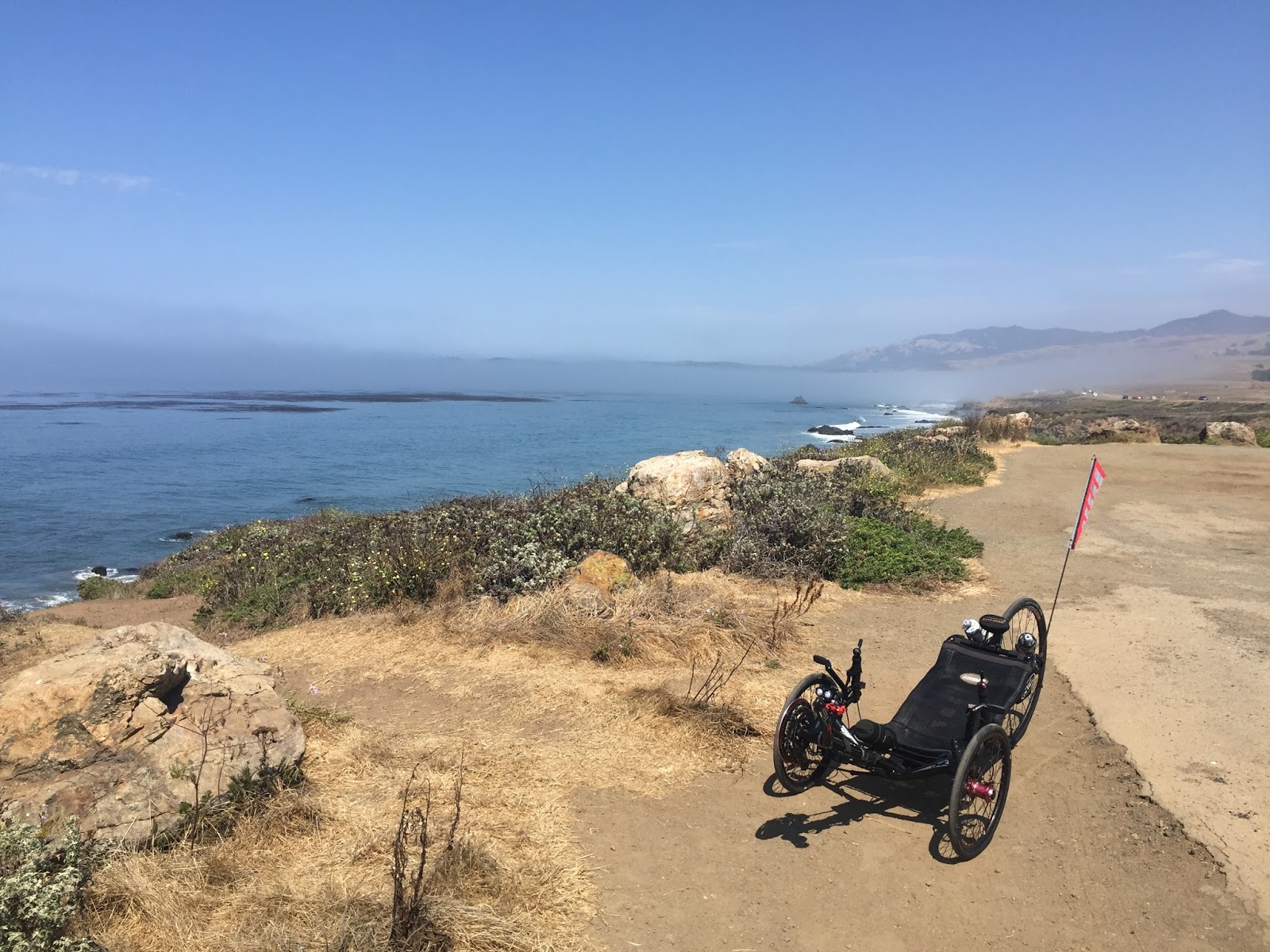
Along HWY 1 north of Cambria in the area of Hearst Castle you'll find some of the best Central Coast riding around. You're riding close to the coast line and there's many opportunities to pull off the road and take it all in. As us bent riders know it's so easy to see it all from the comfort of a laid back seat.